Tag Archives: Online Advertising

ChatGPT Now Includes Paid Ads

ChatGPT Now Includes Paid Ads

Why does ChatGPT now include ads, and who actually sees them?


ChatGPT now includes paid ads as part of a broader strategy to expand access to AI while preserving user trust. Ads are currently live in the U.S. on the free and “Go” tiers of ChatGPT. They are clearly labeled, visually separated from answers, and designed not to influence responses.

Key points:
• Ads appear only on Free and Go plans, not on Pro, Business, or Enterprise subscriptions.
• Answers remain independent and optimized for usefulness, not advertisers.
• User conversations remain private and are not sold to advertisers.
• Users have control over personalization and can opt out or clear ad-related data.
• Ads do not appear near sensitive topics such as health, mental health, or politics.

In short, ChatGPT now includes paid ads to support broader access to AI tools—while maintaining transparency, privacy, and answer integrity.

What It Means for Users and Brands

Artificial intelligence has become a daily assistant for learning, planning, researching, and decision-making. As adoption scales, the economics behind large-scale AI systems matter. With paid ads now live inside ChatGPT, the platform has entered a new phase in how conversational AI supports broad access while sustaining long-term growth.

At Zenergy Works, we view this development not as a disruption, but as an evolution. Advertising inside a conversational interface introduces new considerations for users, businesses, and marketers. The key question is no longer if ads will appear—but how they are implemented and what guardrails define the experience.

Why Advertising Is Now Part of the ChatGPT Ecosystem

OpenAI introduced advertising as part of its broader mission to expand access to AI. The objective is to ensure powerful AI tools are not limited only to those who can afford premium subscriptions.

The current tiered structure includes:

  • A Free tier with usage limits
  • A low-cost “Go” subscription at $8/month in the U.S.
  • Pro, Business, and Enterprise tiers that remain ad-free

Ads are live in the U.S. for logged-in adults on the Free and Go plans. The model supports sustainable revenue while reducing pressure to restrict access or raise subscription costs.

OpenAI has emphasized that advertising is designed to support long-term accessibility—not short-term engagement optimization. The company does not optimize for time spent in ChatGPT but for trust and user experience. That distinction is significant in a digital ecosystem historically driven by attention metrics.

How Ads Appear—And How They Don’t

A central concern when ChatGPT introduced paid ads was whether answers would become biased. OpenAI has stated that ad placements do not influence ChatGPT’s responses.

Ads are:

  • Clearly labeled as sponsored
  • Visually separated from organic answers
  • Positioned at the bottom of responses when contextually relevant

For example, a recipe query may be followed by a sponsored grocery recommendation. A travel discussion could include a clearly marked lodging listing. The conversational answer remains intact; the ad appears adjacent, not embedded within the reasoning.

Additional safeguards include:

  • No ads shown to users under 18 (based on declared or predicted age)
  • No ads near sensitive topics such as health, mental health, or politics
  • The ability to dismiss ads and provide feedback
  • Options to turn off personalization or clear ad-related data

For users concerned about privacy, OpenAI has reiterated that conversations are not sold to advertisers. Data remains protected, and personalization controls are available.

A New Format: Conversational Advertising

Advertising inside AI interfaces introduces a fundamentally different format. Traditional digital ads are static: banners, search listings, display placements. Conversational advertising creates the potential for interactive engagement.

Emerging possibilities may include:

  • Asking product-specific questions within the ad interface
  • Clarifying features, availability, or comparisons
  • Receiving tailored answers in real time

If executed thoughtfully, ads can function as interactive decision-support tools rather than passive interruptions.

For small businesses and emerging brands, this shift may be transformative. AI-powered creative tools reduce production barriers and allow organizations to build high-quality promotional experiences without enterprise-scale budgets.

From a strategy standpoint, this represents a new layer in what we call Generative Engine Optimization (GEO). Visibility increasingly depends on contextual relevance, clarity, and trust—not just keyword ranking.

Trust, Privacy, and Control: The Guardrails That Matter

Advertising inside AI systems is viable only if trust remains intact. OpenAI has outlined several guiding principles:

  • Mission alignment: Advertising supports broad AI access.
  • Answer independence: Sponsored content does not influence responses.
  • Conversation privacy: User data is not sold to advertisers.
  • Choice and control: Personalization can be turned off; data can be cleared.
  • Long-term value focus: User trust outweighs ad revenue optimization.

These guardrails are critical. Without them, the credibility of AI-assisted decision-making would erode quickly.

For subscription users, the model remains unchanged. Pro, Business, and Enterprise accounts continue to operate without ads. This reinforces a diversified revenue approach—subscriptions remain core, while advertising serves as an additional access mechanism rather than the primary driver.

At Zenergy Works, we consistently advise clients that sustainable digital ecosystems require balanced monetization. A single revenue stream often distorts incentives. Diversified models, when transparently implemented, create resilience without sacrificing integrity.

Strategic Implications for Businesses and Marketers

Now that ChatGPT includes paid ads, the ripple effects extend beyond platform policy. Conversational AI is evolving into a hybrid between search engines and dialogue systems. For brands, that means:

  • Contextual relevance matters more than keyword volume
  • Clear value propositions outperform vague messaging
  • Structured, trustworthy content remains foundational
  • AI visibility strategies must account for sponsored placements

AI interfaces are no longer just answer engines—they are discovery engines. That shift influences media strategy, content architecture, and performance measurement.

Organizations should monitor format evolution carefully. Early advertising models often refine based on user behavior and feedback. A measured, data-driven approach is preferable to reactive strategy shifts.

The Future of AI Access: A Balanced Model

The introduction of ads into ChatGPT represents a balancing act: expanding access while preserving trust. If implemented according to the stated principles—clear labeling, answer independence, privacy safeguards, and user control—it provides a sustainable path forward.

At Zenergy Works, we help organizations navigate shifts in search, AI visibility, and digital strategy with clarity and data-driven insight. If you are evaluating how conversational AI advertising may affect your brand or marketing approach, we invite you to connect with our team for a thoughtful discussion.


What’s New for October 31, 2013 – Bing Optimization, Instagram Ads & Mozilla Lightbeam

Do You Optimize for Bing?

All SEO professionals and clients know that Google is the king of organic search. Searchmetrics recently released a report detailing the Bing Ranking Factors for Bing and it includes a Rank Correlation study for Bing to evaluate the factors that differentiate better-positioned websites from those with lesser rankings.

Searchmetrics studied over 10,000 keyword streams and 300,000 websites appearing in the top 30 search results and were able to identify 5 factors that seemed to heavily influence rankings. The 5 factors are listed here:

  • Quality content is a factor. The correlation on Bing was that sites with more text on them, in general, had better rankings. Bing tended not to rank pages with lots of pictures, while Google was the opposite.
  • Social signals help rankings, and Google+ “plus ones” had a significant rankings correlation, as did Tweets and Facebook Comments.
  • Known brands tend to have higher rankings and there are more Exact Match Domains (EMDs) ranking in the top ten search result listings, on average, at Bing.
  • Link numbers are significant. Approximately 53 percent of the backlinks of websites ranked among the top 30 results on Bing contained keywords in the anchor text. This is about 10% higher than Google.
  • Surprisingly, SEO elements such as H1 headings, site speed, and keyword-rich meta descriptions had a low correlation to high rankings. Positive on-page factors were present in nearly every page appearing in the top 30 search results at Bing, making good on-page SEO the prerequisite to obtaining good rankings.

Bing Search Rankings

Instagram Ads To Start This Week

A very small, select group of advertisers will begin introducing high quality brand-oriented ads that include video and imagery, into the Instagram news feed. The Instagram advertisers include Adidas, Levi’s, PayPal, Macy’s, Starwood Hotels and others, and were chosen because they have high-quality ads. The ads are designed to have a high level of artistic value and be more brand-centric than direct response in nature. Instagram’s take on the new ads is as follows:

“Our aim is to make any advertisements you see feel as natural to Instagram as the photos and videos many of you already enjoy from your favorite brands. After all, our team doesn’t just build Instagram, we use it each and every day. We want these ads to be enjoyable and creative in much the same way you see engaging, high-quality ads when you flip through your favorite magazine.”

The ads will have the ability to be targeted in nature, although the quality of the “rifle shot” online advertising approach remains to be seen.

Instagram Ads

Mozilla Lightbeam Helps You Find Out Who Is Watching You on the Internet

Mozilla, the open-source software company that makes the Firefox browser, wants to make it a bit easier for you to visualize what sites and third-party site services might be tracking or watching your Internet activity. The new add-on for your Firefox browser called Lightbeam lets you know who is watching you online.

Lightbeam offers a very clear toggle that allows you to turn which tracking you contribute to the service on and off. Download the add-on and try it.

Mozilla Lightbeam

Bottom Line: Privacy increases, new ad campaigns that promise to be targeted on social media… does anyone else see the potential new trend here? Social Media sites have targeted information, while search engines continue to fight privacy initiatives to continue to track data. If your business has a significant online marketing platform, these trends bear watching.

Eric Van Cleave is a Partner in Zenergy Works, a Santa Rosa, California based SEO, Website Design, and Online Marketing Firm.

What’s New For October 10, 2013 – Hummingbird, Product Descriptions, Ad Revenue

New Hummingbird Google Algorithm Update Complicates SEO

On October 1st, Google announced a rewritten algorithm called Hummingbird. The announcement stated that the new algorithm was released a month or so ago. Google is being extremely tight-lipped about the update and its exact effect on rankings, but we know that longer-tailed keyword streams that relate to searches for specific useful content, social shares, and the longer search phrases that occur in voice search, as well as Google Authorship, are key components of the change.

Google claims that these changes should not affect rankings, and we have not seen rankings affected for our clients, but the chatter online continues to focus on the changes on August 24th and September 12th related to this update.

Google Hummingbird

Product Descriptions: Not Necessarily Unique Content?

Product descriptions, which have been shared amongst numerous ecommerce sites for years and have been re-written to be unique content by many SEO firms and webmasters, may not need to be unique, according to recent comments from Google’s John Mueller during Google Webmaster Hangout. If you jump about 20 minutes into the video, you will hear the following:

“Let’s say a company uses product descriptions on their own site and at the same time provides the descriptions via a database to official retailers who might reuse them on their website. How can correct content attribution / ownership be ensured?”

John answered that in these cases, Google doesn’t look into the ownership of the content. See the comments below:

“So, for example, if there’s an online store that’s selling a book, and it’s selling it worldwide, and there’s also a local bookstore that’s selling the same book and on the site they have the same description as the big general online store, and if we can recognize that a user wants to find local content, then maybe we’ll show them the local version.

And if we can recognize that the user doesn’t want to find just local content but something maybe they can buy online, then maybe we’ll show them the global version…

So it’s not something where we’d say that if you wrote this product description your site will always be ranking for queries for that product description, but rather we’ll try to show them the appropriate version that matches what we think the user is looking for.”

This changes the focus from unique product descriptions in ecommerce to content that identifies the site as the best response for that search in the scope of what the searcher is seeking.

Internet Advertising Bureau: Digital Ad Revenues and Search Revenue Up From Last Year

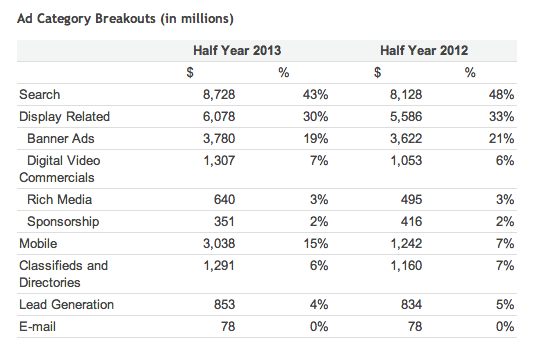
Total digital ad revenue in the United States for the first six months of 2013 was just under $20.1 billion, versus $17 billion in the same period of 2012. Mobile ad spending represented 15 percent of the total. Search revenues were up to $8.7 billion, a 7% increase from last year. The full results are broken out below:

Digital Ad RevenueBottom Line: Is Google making organic search so difficult to optimize that the cost will become prohibitive for most small to medium sized businesses? Will PPC and Display ads, along with social media and other strategies, overtake SEO? This is a trend that bears watching as businesses continue to improve tracking of their metrics and the return on investment from their online ad dollars.

Eric Van Cleave is a Partner in Zenergy Works, a Santa Rosa, California based SEO, Website Development and Online Marketing Firm.

Building a Creative Online Campaign

When you’re braving the choppy waters of internet marketing, it can be easy to get lost. Sometimes it feels like you’re just throwing spaghetti at a wall just to see what sticks. There must be a better way to build a compelling campaign!

There is.

First, let’s go over the basics: marketing is about experimentation and a willingness to try and try again. Even the most successful companies in the world deal with their fair share of dud marketing campaigns… and these are businesses with entire dedicated marketing departments at their disposal. The occasional failure is part of the game.

The other part of the game is having the wherewithal to recognize why something didn’t work. Or better yet, why it did. You can’t just give up because your first, second, or even third attempt to navigate the waters turned up mediocre results.

Creative Campaign

Creativity is key.

Photo Credit: AlicePopkorn via Compfight cc

Here’s some advice to help in creating a compelling, creative campaign.

  • Do your research. Do you know what your current or potential audience wants? Are you sure? Seek out what your competitors are doing online. What’s working for them? What’s not? What do you have that can fill a niche they can’t? Use it.
  • Make it personal without losing your core messaging. What’s going to make people care about your marketing efforts? Maybe you can be a hub for local events, or post pictures of the sort of goofy fun you have in your shop every day. If your audience is parents, share content that will resonate with them, like parental humor or photos of your kids. Just don’t forget that you’re also trying to get them to DO something.
  • Invest in high-quality imaging. Social sites and many websites are moving toward highly visual designs that often rely on high-quality images. Visual storytelling has proven to be something the public reacts to very strongly. Stunning photography or carefully crafted designs convey a level of professionalism and, done correctly, are highly sharable. Can you create creative visual messaging?
  • Learn the art of story. Do you know how to tell a story in 100 words? It’s an important skill to learn. You’ll often hear that “Content is King,” and it’s the truth. People respond to interesting, entertaining, or valuable content. Blend mediums. How can you combine sound and text? Video and audio? Images and story? It doesn’t hurt to brush up on your grammar, too. Polished text is professional text.
  • Be willing to change direction. You may find that something you did on a lark ended up with ten times the reaction of your usual efforts. Don’t wave it off as a fluke. If something you do finds a foothold, be willing to lean further in that direction, even if it means abandoning other “safer” efforts.
  • If you don’t have the bandwidth to do it internally, hire a professional. As in, a professional internet marketer with experience and a portfolio. Many people claim expertise in the digital realm, and if you’re not very familiar, in can be difficult to determine who really knows their stuff. So insist on seeing success stories.
  • The product or service must deliver. Okay, you’ve done your job well and set up a plan that will draw people to you (hopefully) in droves. Now you have to deliver what they were promised.

Above all, find what makes you stand out and don’t be afraid to experiment. Do something completely different! Write a mini-play. Film a video. Think of the advertising that really sticks with you, then put your own spin on it. This isn’t easy, but if you strike the right balance, it can be explosive!

Stephanie Wargin is the Social Media Strategist at Zenergy Works, a web design and SEO company located in Santa Rosa, California. Her friends like to brush her hair into her eyes whenever she talks about Facebook.

LinkedIn At 200 Million Members-A Great B to B Online Advertising Opportunity

Just 2 years after celebrating an increase to 100 million members, LinkedIn is announcing that they are now at 200 million members. The 200 million current members include professionals from over 200 countries & territories across the world. There is a tremendous business to business opportunity for an online advertising campaign.

Review this infographic from LinkedIn that breaks down the members by industry and location.

Bottom Line:  LinkedIn is not just for recruiting anymore. It is an opportunity for online advertising. The new advertising platform allows an advertiser to target a certain type of client, and has a database of roughly 40 million U.S. businesses and 175 million businesses worldwide.  If you sell business to business or if you would like to join others in your vertical to network with, LinkedIn can provide an excellent opportunity for your business.

Eric Van Cleave is a Partner in Zenergy Works, A Santa Rosa, California Social Media Optimization, Online Marketing, Website Design and SEO Firm.