Tag Archives: Online Reviews

Google Is Cracking Down on Reviews (Again)

Google Is Cracking Down on Reviews (Again)

is Google is cracking down on reviews again?


Google is tightening enforcement around business reviews again, and many companies are seeing reviews disappear from their Google Business Profiles. The main targets of this crackdown are suspicious review spikes and incentivized reviews. If a business suddenly receives dozens of reviews in a short period of time or offers rewards in exchange for a positive rating, Google’s systems may flag or remove those reviews.

Google’s goal is simple: protect the integrity of reviews so customers can trust what they read. Reviews remain one of the most important ranking factors for Google Maps and local search results, but they must come from authentic customer experiences.

To stay compliant and protect your visibility in search results, businesses should focus on sustainable review strategies:

• Maintain a steady stream of reviews rather than large bursts
• Encourage customers to write detailed feedback about their experience
• Avoid offering incentives in exchange for positive reviews
• Use automated systems to request reviews consistently and naturally

Google isn’t trying to punish legitimate businesses. Instead, the platform is working to reduce manipulation and ensure reviews accurately reflect real customer experiences. Businesses that prioritize authenticity and consistency will continue to benefit from reviews as a powerful tool for visibility and trust.

Google Is Cracking Down on Reviews (Again)

If you recently logged into your Google Business Profile and noticed that some reviews had disappeared, you’re not imagining things. Google has once again increased enforcement of its review policies, and businesses across many industries are seeing reviews removed without warning.

Over the past several weeks, profiles that experienced unusual spikes in review activity or appeared to be collecting incentivized feedback have been the most affected. Google’s systems are designed to detect patterns that look unnatural. For example, if a business normally receives two reviews per month but suddenly receives dozens in a single weekend, it may trigger an automated review audit.

For businesses that rely on reviews to support their online reputation and visibility, understanding these policy updates is essential.

Why Google Is Removing Reviews

OpenAI introduced advertising as part of its broader mission to expand access to AI. The objective is to ensure powerful AI tools are not limited only to those who can afford premium subscriptions.

Several behaviors now receive stronger scrutiny:

  • Sudden spikes in review volume
  • Reviews coming from newly created or suspicious accounts
  • Multiple reviews posted from the same location or IP address
  • Incentivized reviews tied to discounts, giveaways, or rewards

Offering incentives such as “free dessert for a five-star review” or gift cards in exchange for feedback directly violates Google’s guidelines. Even well-intentioned promotions can cause legitimate reviews to be removed.

Google’s goal is not to penalize honest businesses. Instead, the platform is trying to ensure that reviews reflect genuine customer experiences.

Why Consistency Matters More Than Volume

One common misconception is that the total number of reviews is the most important factor. While review volume helps, Google increasingly prioritizes recency and consistency.

Google’s algorithm places strong emphasis on reviews written within the past 90 days. A business could have hundreds of reviews from previous years, but if there are no recent ones, the profile may lose momentum in local search rankings.

A healthier strategy is to focus on steady growth. Rather than trying to generate large bursts of reviews, businesses should aim for a predictable flow over time.

A realistic goal for many companies is:

  • One new review each week
  • A steady pattern of feedback over several months
  • Consistent engagement with customer responses

This approach creates a natural review history that Google’s systems view as more trustworthy.

Detailed Reviews Help Search Visibility

Another often overlooked factor is the quality of reviews, not just the star rating.

When customers write detailed reviews describing their experience, they often mention services, products, locations, and specific interactions. These natural keywords help Google better understand what the business offers and can improve visibility in relevant searches.

Encouraging thoughtful feedback benefits both customers and search performance. Helpful reviews often include:

  • A description of the service received
  • The location where the experience took place
  • Specific team members or departments
  • Photos showing the service or product

Images added to reviews can be especially valuable. Visual content increases engagement and provides additional credibility to the review.

For businesses, the key is simply encouraging customers to share their honest experiences in their own words.

Automating Review Requests the Right Way

One challenge many business owners face is remembering to consistently ask for reviews. Manually requesting feedback can feel awkward, inconsistent, or easy to forget during busy days.

Automation can help solve this problem while keeping review collection compliant with Google’s policies.

Automated review systems allow businesses to:

  • Send review requests after a completed service
  • Maintain a consistent review flow
  • Avoid uncomfortable in-person requests
  • Ensure customers receive the request at the right moment

Instead of relying on memory or sporadic outreach, automation creates a steady process that runs quietly in the background.

Tools like Paige, for example, can automatically request reviews at the ideal time, assist with generating optimized review responses, and help businesses stay engaged with customer feedback.

The result is a review strategy that feels natural to customers and sustainable for business owners.

Authentic Reviews Are the Future of Local SEO

As Google continues improving its review policies, one message is clear: authenticity matters more than ever.

Businesses that focus on genuine customer feedback, steady review growth, and transparent practices will remain in a strong position. Reviews still play a major role in how customers choose businesses and how Google ranks local results.

Trying to manipulate the system with incentives or sudden review campaigns can create short-term gains but long-term risk.

A better approach is simple:

  • Provide a great experience
  • Make it easy for customers to leave feedback
  • Maintain a consistent review strategy

Over time, this approach builds both credibility and visibility.

The Smart Way to Stay Ahead of Google’s Review Policies

Google’s latest review crackdown highlights an important shift in how online reputation management works. Authenticity, consistency, and transparency are now the foundation of a strong review strategy.

Businesses that focus on real customer experiences rather than shortcuts will continue to benefit from one of the most powerful ranking signals in local search.

If you want to simplify the process and build a compliant review strategy that runs automatically in the background, the team at Zenergy Works can help you implement tools and systems that make review growth easier and more sustainable. Contact us today to learn more! 

Considering the Customer’s Perspective

One of the most difficult things in the world to do is take a look at yourself through a different lens. When we look at ourselves or our businesses, we see the full context of our experience, from startup to present day. We know exactly why everything is the way it is, why certain decisions were made, and are often heavily invested in the method we’ve used to build what we have.

It’s tough to take a step back and look at things from another perspective. Sometimes we’re too close to the company not to take criticism personally. It’s often a business owner’s first instinct to go on the defensive and try to over-explain, or worse, get obviously upset with a customer.

New Perspective

Try looking at things from another angle… like the customer’s point of view.

Photo Credit: kevin dooley via Compfight cc

Unfortunately, we must remember that other people are only seeing things from the outside. We’ve had many clients get ruffled over a negative Yelp review, explaining how the reviewer had a skewed experience or is just flat-out wrong. There are a few things to keep in mind in these instances.

An outside perspective can give you new insight. You may immediately bristle at criticism of your business, but it’s vital to pay attention and seriously consider what your customers are saying. Even if you ultimately disagree, remember that they’re seeing things from a different angle, and that angle can be invaluable. They may uncover something that you never see because you’re too close.

Remember that customers have a limited view. Many businesses respond to negative sentiment with explanations, but when you’re online, these exchanges have a very different tone for your customers. Regardless of how polite you are, explanations come off as excuses and any implication that the customer may be wrong will be met with offense. Worse yet, uninvolved parties may feel you’re being confrontational and defensive, and wonder what you’re hiding.

Negative sentiment is a catalyst for change. Instead of trying to explain issues away, always thank customers for their feedback and verbalize the steps you’re taking toward ensuring their negative experience isn’t repeated. Then consider their feedback critically and decide what changes really do need to occur, if any.

Learn which battles are worth fighting. We all know that there are customers that will never be happy no matter what you do. They come into a complaint looking for a fight with their teeth bared. The reasons why this happens are unimportant. What’s important is to remember that when you’re dealing with customers like this publicly or online, you have a silent audience watching in the wings. Keep your head, stay classy, and show that you’re making a true effort to rectify the situation. Even if the initial customer can’t be appeased, other customers will take note of your behavior.

These are some of the many ways you can turn potentially negative criticism into something that makes your business stronger. In addition to customer insights, you may want to ask another outside agency or knowledgeable individual to give their thoughts on how to improve your business. When you hear suggestions, try to consider them with an open mind, even if your first impulse is to reject them. It may be just what you need to reinvent your business!

Stephanie Wargin is the Social Media Strategist at Zenergy Works, a web design and SEO company located in Santa Rosa, California. Her friends like to brush her hair into her eyes whenever she talks about Facebook.

What’s New for October 3, 2013 – Fake Online Reviews & Studies Galore

Study: 15% of US Adults Do Not Use the Internet

15% of Americans age 18 or older do not use the Internet, and 9% said they don’t use it in their homes, according to a report released by Pew Research Center. Those that do not use the internet cited reasons like: lack of interest, cost, lack of internet access, too busy, or feel that the internet is a waste of time. More than 40% of respondents above the age of 65 do not use the Internet, while just 2% in the 18-29 age range don’t use it.

Internet Adoption Since 1995

The truly staggering statistic is that less than 20 years ago (an eternity in tech advancement terms), 85% of people did not use the Internet. The chart below shows the rate of internet adoption among American adults since 1995.

Study: Facebook Logins Still #1, But Google+ Is Gaining

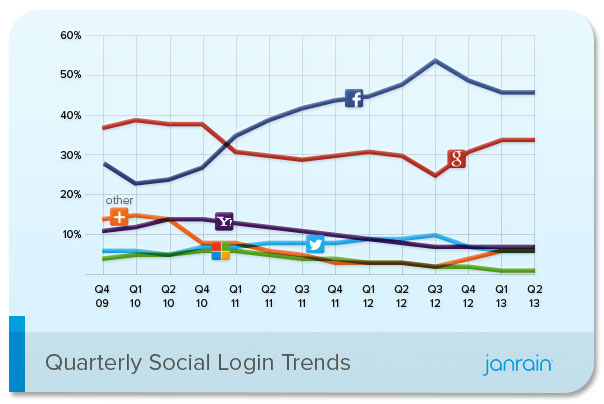
Janrain has released a study on social login usage and the results showed that Facebook is still the leading social login service with a 46% usage rate. Google+ is gaining and now claims 34% of the social logins, a solid second-place showing.

Social Login Trends

Fake Online Reviews Cost 19 Firms Large Fines in New York

The importance of online reviews has led to the growth of firms that charge to write glowing reviews on sites like Yelp and Google+. New York Attorney General Eric Schneiderman has announced agreements with 19 of the bogus review companies to stop the practice and pay $350,000 in fines. Reportedly, the California Attorney General’s office is looking into similar issues in that state.

Gartner estimates that by 2014, some 15 percent of online reviews will be fake. The Federal Trade Commission released new guidelines in March trying to address all the new ways consumers get information about purchases. Under the guidelines, if someone is compensated for writing a review of a business, they must disclose the relationship. Yelp and other review sites work diligently to sniff out fake reviews (i.e. the person in Houston reviewing a carpet cleaning firm in San Diego), but the rewards in online placement and conversion for some businesses tempt them to try and outsmart the system.

Bottom Line: The following myths have been dispelled by this week’s research information:

  1. Everybody is not online.
  2. Fake reviews are not the way to build placement and conversion overnight.
  3. Google+ may catch up to Facebook yet. Time will tell.

Who knew?

Eric Van Cleave is a Partner in Zenergy Works, a Santa Rosa, California based Website Development, SEO and Online Marketing Firm.

Good SEO – First Page Gets the Clicks!

Chitika has done a new study that shows that good SEO is still vitally important in online marketing. Sites on the first Google search results page generate 92% of all traffic from an average search. The last study on this was done in 2010, but the basic finding seems to be the same-get found as high as possible on the first page of SERP.

best SEO

Be Careful in Editing Google Place Categories

Jade Wang from Google’s local business team has announced that if you see new categories in your business listings, do not update them manually. According to Jade, Google is working on a fix for this issue and if you edit the categories, you could make the problem worse.

Jade wrote in the Google Business Help Forum:

We’ve found a technical issue affecting some users that causes a handful of new categories are showing up in Places dashboards. We’re working on a fix and will come back with an update when we can. Please do not edit these categories for now while we work on the issue. Please note that these categories do not show on the publicly-available listing.

Online Reviews 

New Study: 79% of Searchers Trust Local Online Reviews

BrightLocal has released the findings of its 2013 Local Consumer Review Survey. This year’s survey shows that more consumers are reading online reviews as part of their pre-purchase research before selecting a local business to use.  It also shows that consumers are forming opinions faster and reading fewer reviews before they trust (or don’t trust) a local business. This puts increased emphasis on local businesses to manage their online reputation closely and ensure that any negative reviews are dealt with in a swift and positive way.  Here is a summary of the findings:

  • 85% of consumers say that they read online reviews for local businesses (up from 76% in 2012).
  • 67% of consumers read 6 reviews or less (up from 52% in 2012)
  • 73% of consumers say positive customer reviews make them trust a business more (up from 58% in 2012)
  • 79% of consumers trust online reviews as much as personal recommendations (up from 72% in 2012)

Bottom Line: Information is coming at online marketers at a fast and furious pace. Good SEO is still important, but online reviews are becoming more and more important in converting online traffic into customers. Also, be careful if you see something in a local listing or other online platform that you do not control.  Before you assume that anything has been changed, consult the relevant forums and chat rooms online to see if others have experienced the same issue.

Eric Van Cleave is a Partner in Zenergy Works, a Santa Rosa, California, SEO, Website Development and Online Marketing Firm.